Understanding Tooth Transplant Cost: Beyond Naturalness to Predictability
The Intrigue of the Natural: Deciphering Tooth Transplant Cost

When you begin researching tooth transplant cost, you are likely drawn to the idea of a “natural” solution—the appeal of using your own biology to replace a missing tooth. This curiosity is understandable; it feels intuitive, perhaps even simpler, than artificial alternatives. However, beneath this intrigue often lies a subtle, yet significant, anxiety: the fear of committing to an option that seems appealing in theory but may fail biologically.
The concern isn’t just about the financial outlay; it is the worry that choosing a tooth transplant could lead to a disheartening loss of time, stability, or even future options if the transplanted tooth doesn’t integrate as hoped. You are seeking clarity and control, navigating between the promise of naturalness and the caution against novelty.
Why “Natural” Isn’t Always “Simple”
The confusion surrounding tooth transplant cost exists because the concept itself seems so straightforward: move a tooth from one place to another. This leads to tempting shortcuts that can obscure the true biological complexity:
-
The “Biological” Shortcut: Assuming that because it’s a natural tooth, the process is inherently less risky than using an artificial implant.
-
The “Cost-Saving” Shortcut: Hoping that avoiding manufactured components will automatically lead to a cheaper solution with comparable outcomes.
-
The “Minimal Intervention” Appeal: Believing it inherently minimizes intervention, while overlooking the precise surgical requirements for success.
These shortcuts, while emotionally appealing, ignore the most critical variable: the intricate biology of tooth vitality and integration.
Reframing Tooth Transplants: Focus on Biological Suitability
The false belief that a tooth transplant is a simpler, safer, or cheaper substitute for other permanent solutions often stems from a misunderstanding of what makes a transplant viable. To regain confidence, it is helpful to replace the “novelty” mindset with a Biological Predictability Model.
Success is less about the “idea” of using a natural tooth and more about whether your specific biological variables align:
-
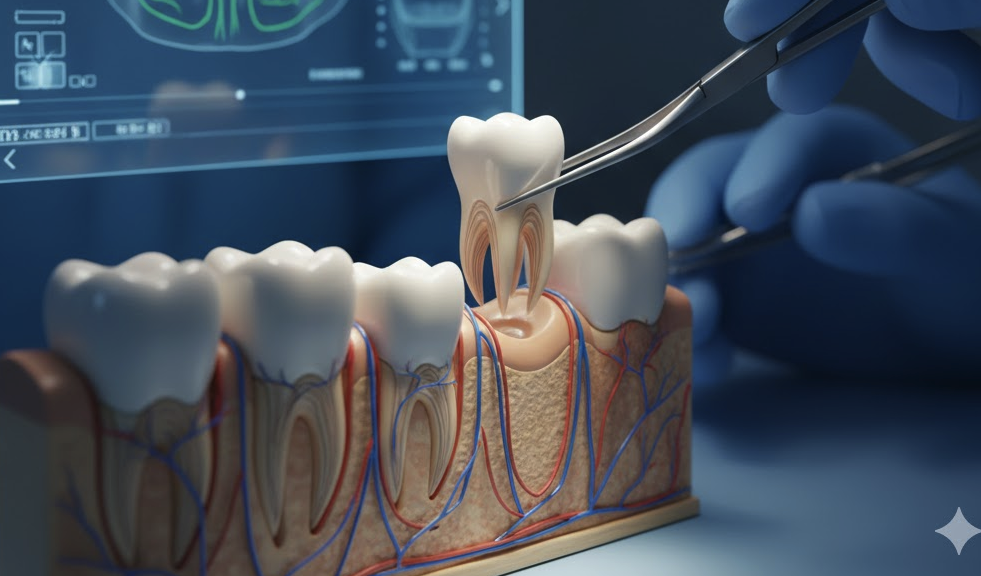
Donor Tooth Viability: The donor tooth must have specific root development and a healthy pulp (nerve) to survive the transfer.
-
Recipient Site Health: The socket where the tooth is placed must be free of infection and have an adequate blood supply.
-
Timing and Technique: The precise handling of the tooth during extraction and placement is paramount to maintaining the vitality of the cells on the root surface.
Biological Readiness Checklist: Verifying Your Suitability

Before moving forward, look for these four specific indicators in your clinical report or 3D scans. Their presence helps verify if you are a truly viable candidate for a predictable transplant outcome.
-
Root Apex Status (Open vs. Closed): The highest success rates often occur when the donor tooth’s roots are only two-thirds formed (open apex). This allows for easier re-vascularization (blood flow return) to the nerve. If the roots are fully closed, a root canal may be required shortly after the transplant.
-
Periodontal Ligament (PDL) Health: The “magic” of a transplant lies in the PDL—the microscopic fibers on the root. The clinician must confirm there is no history of trauma to the donor tooth that could have damaged these cells, which are essential for the tooth to “bond” to the new socket.
-
Recipient Site Volume: A 3D CBCT scan must confirm that the new site has enough bone width and height to house the donor tooth without the tooth touching the sinus floor or nerve canals.
-
Meso-Surgical Precision: Check if the plan includes a “3D-printed tooth replica.” Modern surgeons often print a plastic model of your donor tooth to “test fit” the recipient socket, minimizing the time the real tooth spends outside your body.
Decision Scenarios: Evaluating Biological Fit
-
The Developing Donor Scenario: You are a younger individual with an unerupted wisdom tooth. What matters: Pulp vitality and root development.
-
The Recent Extraction Site: You’ve just lost a tooth, and the socket is fresh. What matters: Immediate placement and blood supply.
-
The Compromised Recipient Site: The missing tooth area has bone loss. What matters: Rebuilding the foundation before considering a transplant.
Context Comparison Table: Assessing Transplant Predictability
| Factor | Standard (Basic) Approach | Comprehensive Biological Assessment | Advanced Micro-Surgical Planning |
| Decision Certainty | Lower; relies on general conditions | High; based on detailed biological scans | Very High; uses 3D-printed replicas |
| Long-term Predictability | Variable; higher risk of “rejection” | Good; if conditions are optimal | Highest; uses stringent selection criteria |
| Planning Complexity | Visual assessment, basic X-rays | 3D CBCT scans, vitality testing | Micro-CT and virtual test-fitting |
| Risk if Assumptions Fail | Tooth loss; need for alternative | Potential for complications, but managed | Minimal; robust pre-screening |
| Flexibility Over Time | Limited; may require future alternatives | Potential for root canal, but tooth remains | Functions like a natural tooth |
Restoring Control and Normalizing Research
The most important step in reducing the anxiety surrounding tooth transplant cost is to realize that the concept’s appeal shouldn’t overshadow a thorough assessment of its viability for your body.
Normalize the research phase. Professional help at this stage should be framed as clarification, not commitment. A consultation is a data-gathering mission where a professional determines if you are a suitable biological candidate. You are the final authority on when the biological logic of the solution outweighs the fear of novelty.
The Value of Clarity
Confidence is the byproduct of understanding biological alignment. When you stop asking, “What is the cost?” and start asking, “Do my specific biological conditions align with the requirements for a predictable transplant?”, the anxiety of the unknown begins to lift. You move from a position of intrigued curiosity to one of informed evaluation.
Reassurance and Decision Safety
The safety of a tooth transplant isn’t found in its “naturalness” but in the meticulous assessment of biological suitability and surgical precision. Take your time to understand your unique anatomy and the health of potential donor teeth. When the path forward feels logically sound and respects your specific biological variables, you can proceed with the peace of mind that comes from true clarity.