Understanding the Average Cost of Dental Implants: A Guide to Risk & Value
Beyond the Benchmark: Decoding the Average Cost of Dental Implants
When you begin searching for the average cost of dental implants, you are likely looking for a safety net. In an environment of high-stakes medical decisions, an “average” feels like a shield—a way to validate that you aren’t being overcharged or, conversely, choosing a “discount” option that might compromise your health. It is a logical attempt to anchor your expectations and reduce the fear of making an abnormal or poor choice.
However, it is important to realize that the “average” is a statistical descriptor, not a clinical prescription. The hidden fear isn’t actually about the number; it is the fear of deviation. You worry that if your quote is higher than the average, you are being exploited, and if it is lower, you are taking a dangerous risk with an irreversible procedure.

Why the Search for a Norm Fails
The confusion surrounding the average cost of dental implants exists because the dental industry rarely operates on a “one-size-fits-all” manufacturing model. Instead, every implant is a bespoke integration into a unique biological system.
When faced with this variability, shortcuts become incredibly tempting:
-
The “Market Rate” Shortcut: Assuming there is a standardized price for “the screw” itself.
-
The Brand Shortcut: Believing a specific logo or manufacturer name is the primary determinant of safety.
-
The Speed Shortcut: Opting for the fastest turnaround to minimize the time spent in a state of uncertainty.
These shortcuts feel like they offer control, but they often ignore the most critical variable: your unique anatomy. If you try to force your personal clinical reality into a statistical “average,” you risk ignoring the specific safeguards your body may actually require for long-term success.
Reframing the Average: Descriptive vs. Prescriptive
The false belief that an average cost of dental implants applies to your individual situation persists because we treat dentistry like a retail purchase. To regain confidence, it is helpful to replace the “norm-seeking” mindset with a Context-Driven Model.
In this way of thinking, costs don’t fluctuate randomly; they cluster around the biological and planning context of each case. An “average” is simply a collection of many different stories. Your situation is not a statistic to be averaged; it is a set of variables to be managed.
-
Diagnostic Integrity: The difference between a basic visual exam and a 3D digital map of your nerves and bone.
-
Biological Foundation: The health and volume of the bone where the implant will live.
-
Predictability Planning: The use of surgical guides to ensure millimetric precision before the first incision is made.
Diagnostic Guide: Why Your Quote May Deviate

To help move past “anchoring anxiety,” look for these three indicators in your consultation notes or X-rays. They will help you understand why your specific requirement might naturally sit above or below a standard benchmark.
1. The “Bone Gap” Indicator
Look at your X-ray. If the tooth has been missing for a long time, the bone often “melts” away (resorption). If your clinician mentions a bone graft or sinus lift, your case involves rebuilding the foundation. This requires additional bio-materials and healing time, which logically moves the investment above a “standard” baseline.
2. The “Smile Line” Variable
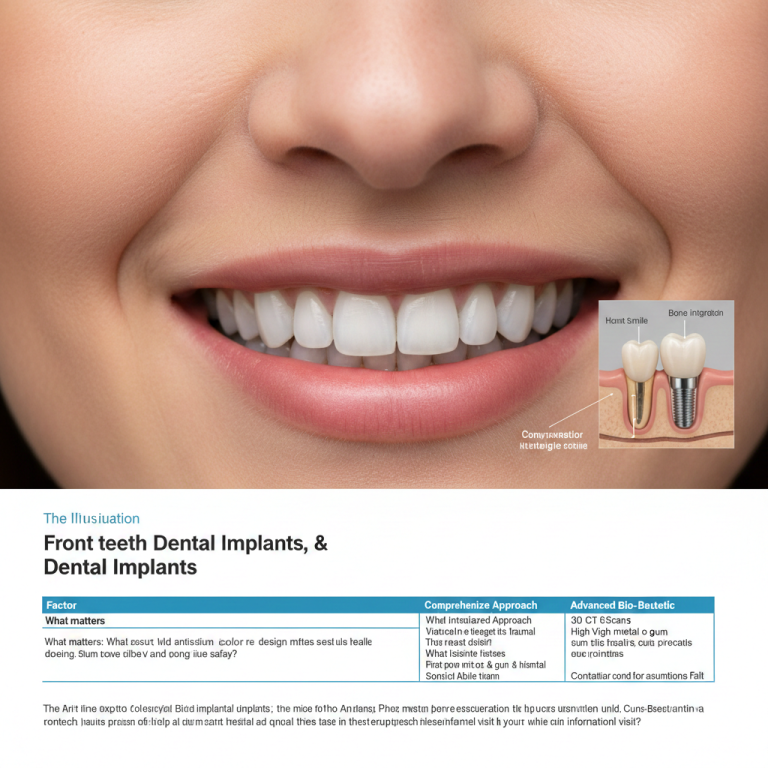
Is the implant for a front tooth? High-aesthetic zones require custom abutments and specialized gum-shaping techniques to ensure the tooth looks natural as it emerges from the tissue. If your case is in the back (molars), the focus is purely on force; if it’s in the front, the focus is on artistry and biology—a more complex variable to manage.
3. The 3D Precision Factor
Check if your consultation included a CBCT (3D) scan. A plan based on 3D data allows for “Guided Surgery,” where a template is 3D-printed to lock in the implant position. This removes the “average” risk of freehand placement, but the digital planning and fabrication involved are resources that sit outside a baseline commodity quote.
Decision Scenarios: Identifying Your Context
-
The High-Aesthetic Zone: You are replacing a front tooth. What matters: Perfect symmetry. The worry: Will a “standard” approach look artificial?
-
The Structural Recovery: You have significant bone thinning. What matters: Rebuilding the foundation. The worry: Are these “extra steps” unnecessary, or a biological requirement?
-
The Functional Molar: You are replacing a back tooth. What matters: Mechanical endurance. The worry: Will a lower-cost option fracture under pressure?
Context Comparison: Planning for Individual Predictability
| Factor | Baseline Planning | Comprehensive Mapping | Advanced Bio-Guided Planning |
| Decision Certainty | Relies on average healing | High; uses patient-specific data | Very High; addresses deficits |
| Long-term Predictability | Variable based on lifestyle | High stability over decades | Highest; for high-risk profiles |
| Planning Complexity | Routine diagnostics | 3D imaging and digital design | Virtual surgery and custom engineering |
| Risk if Assumptions Fail | Revision may be needed | Minimal; risks identified early | Near-zero; contingencies built-in |
| Flexibility Over Time | May require specific parts | Compatible with major systems | Fully modular for future changes |
Restoring Control and Normalizing Research
You are not in a race to conform to a number. If a quote for the average cost of dental implants feels confusing, it is a signal that you need more information about the “why” behind your specific recommendation.
Normalize the research phase. It is perfectly appropriate to stay in a state of “not deciding” until the logic of the clinical plan makes sense to you. Professional help at this stage should be framed as clarification, not commitment. You are gathering data to see how a provider’s approach to predictability aligns with your own tolerance for risk.
The Value of Clarity
Confidence is the opposite of conformity. You don’t gain safety by fitting into a statistical average; you gain it by understanding the specific mechanics of your treatment. When you stop asking, “Is this the average price?” and start asking, “How are you managing the risks of my specific bone density?”, the anxiety of the unknown begins to lift.
Reassurance and Decision Safety
Making a permanent health decision is a process of replacing uncertainty with evidence. The safety of your choice is found in the transparency of the planning process, not in a numerical benchmark. When the path forward feels logically sound and tailored to your biology, you can proceed with the peace of mind that comes from true clarity.