Understanding Dental Implants: A Guide to Decision Clarity & Planning
Navigating the Choice: A Guide to Understanding Dental Implants

When you begin researching dental implants, the search is often driven by a desire for a definitive answer—a “best” brand or a “standard” price that guarantees success. However, the more you read, the more overwhelming the information becomes. Beneath the surface-level questions about hardware lies a deeper, unspoken fear: the fear of making an irreversible mistake.
The anxiety isn’t just about the procedure; it is the worry that a decision made today might lead to long-term regret, affecting your comfort, your ability to eat, or your facial structure in ways that cannot be easily undone. You sense that this is a major health milestone, and you are understandably cautious about being “locked in” to a path you don’t fully understand yet.
The Origin of Uncertainty
The confusion surrounding dental implants exists because they are often presented as a product you “buy,” rather than a medical outcome you facilitate. When faced with a complex health decision, it is natural to look for shortcuts to reduce mental load. You might find yourself gravitating toward:
-
Rankings: Searching for “top-rated” clinics as a proxy for safety.
-
Speed: Being drawn to “immediate” results to bypass the discomfort of waiting.
-
Hardware Brands: Assuming a specific manufacturer is the sole guarantor of quality.
While these shortcuts feel like they offer control, they often ignore the most critical variable: your unique biological landscape. This creates a false belief that success is a matter of choosing the “right” item off a shelf, rather than managing a series of personalized clinical factors.
Reframing the Decision: Outcomes Over Hardware
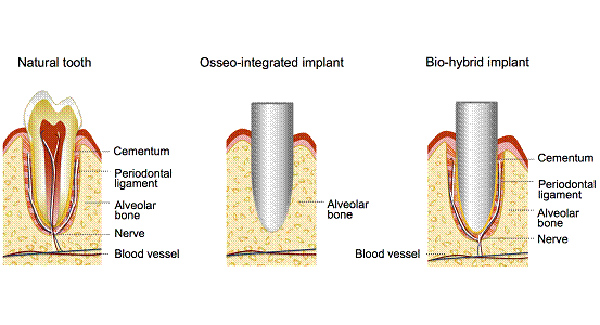
The belief that dental implants are a standardized, one-size-fits-all solution is a common misconception. In reality, success is not determined by the brand of the screw, but by how individual biological and planning factors are managed.
To regain confidence, it is helpful to replace the “product” mindset with a Predictability Model. In this way of thinking, an implant is a category of outcomes shaped by individual conditions. Confidence grows as you understand the variables that influence how a replacement tooth will actually function in your mouth:
-
Biological Integration: How your specific bone density and systemic health (like healing capacity) interact with the implant material.
-
Biomechanical Load: How the implant is positioned to handle the specific pressure of your bite forces.
-
Spatial Architecture: How the restoration fits within the millimetric margins of your existing teeth and gum tissue.
By viewing the process as a series of managed variables rather than a single binary choice, you remove the pressure to “pick correctly” and focus instead on gathering the data necessary for a predictable result.
Decision Scenarios: Mapping Your Context
Recognizing where you stand can help transform a vague sense of overwhelm into a structured path forward.
-
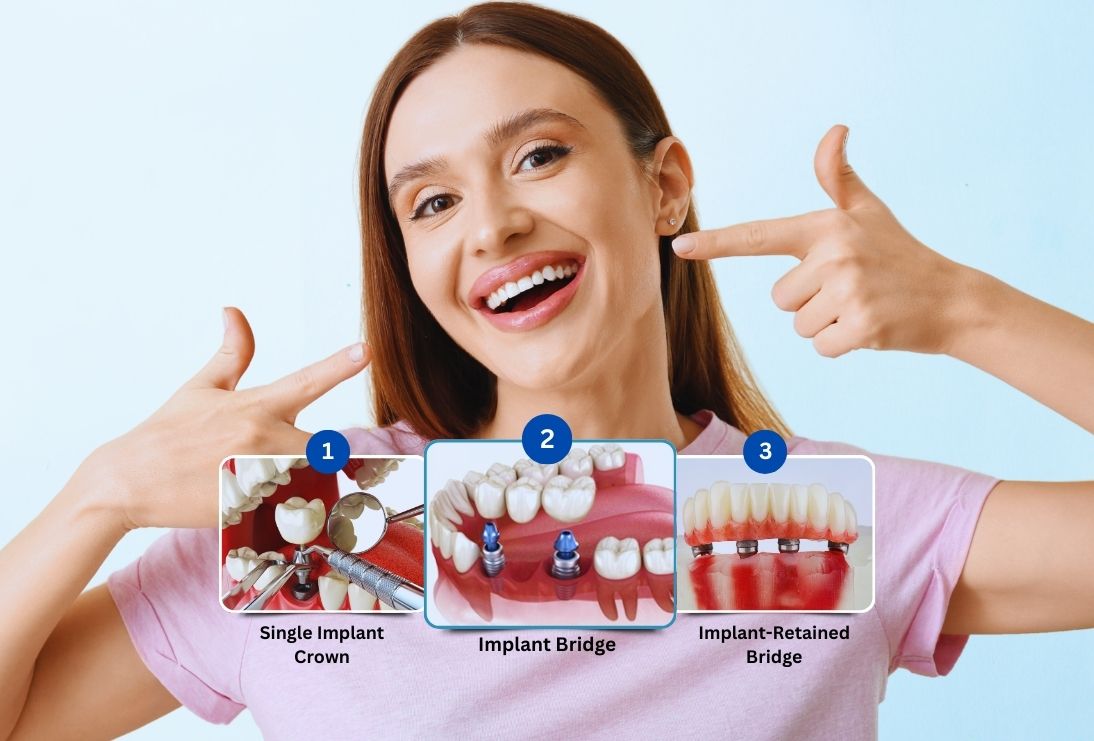
The Single Tooth Restoration: You are missing one tooth in an otherwise healthy mouth. What matters: Maintaining the health of the adjacent teeth. The worry: Will this decision compromise the healthy teeth next to the gap?
-
The Multi-Tooth Gap: Several teeth are missing in a row. What matters: Structural stability and preventing bone loss. The worry: Will the bridge feel artificial or interfere with natural speech?
-
The Comprehensive Reconstruction: Most or all teeth in an arch need replacement. What matters: Total functional restoration and facial support. The worry: The scale of the change feels permanent and potentially life-altering.
Context Comparison: Planning for Predictability
This table outlines how different levels of planning complexity influence the outcome. It is designed to help you see how “risk” is managed through information.
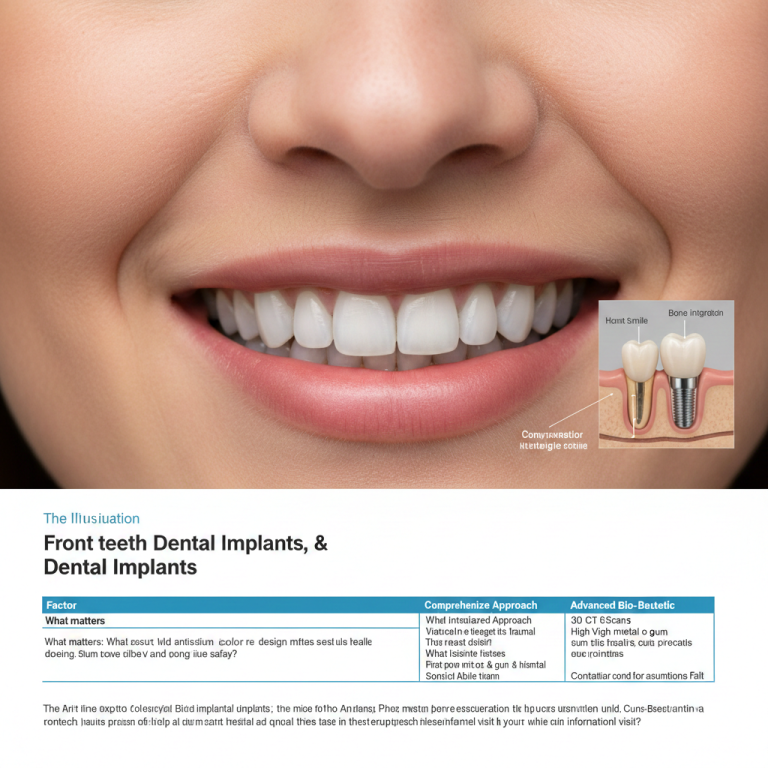
| Factor | Baseline Planning | Comprehensive Mapping | Advanced Bio-Guided Planning |
| Decision Certainty | Moderate; based on standard healing | High; based on 3D imaging | Very High; uses custom surgical guides |
| Long-term Predictability | Relies on average outcomes | Accounts for specific bone volume | Accounts for bite force and tissue margins |
| Planning Complexity | Routine clinical exams | CT scans and digital mapping | Virtual surgery and custom engineering |
| Risk if Assumptions Fail | Revision may be needed | Minimal; risks identified early | Near-zero; contingencies built-in |
| Flexibility Over Time | May require specific parts | Usually compatible with major systems | Fully modular for future adjustments |
Restoring Control Through Research
The most important thing to remember in this early stage is that you are not under any obligation to act. The caution you feel is an asset; it ensures you are doing the necessary due diligence. Normalize this research phase as a vital part of the process.
Professional assistance at this stage should be framed as clarification, not commitment. A consultation is simply a data-gathering mission where a professional explains the biological and mechanical variables of your specific case. You are the architect of the timeline. If you don’t feel you have enough clarity to visualize the long-term outcome, it is perfectly appropriate to stay in the information-gathering phase.
The Value of Clarity
True confidence grows when the “mystery” of dental implants is replaced by a clear understanding of the factors that lead to success. When you move from a state of being “sold” a solution to a state of understanding your own clinical roadmap, the fear of regret begins to dissipate. You aren’t just making a choice; you are building a foundation for your future health based on logic and evidence.
Reassurance and Decision Safety
Making a significant health decision is a process, not an event. The safety of your decision is rooted in your own level of comfort with the information provided. Take your time to understand the “why” behind different planning approaches. When the path forward feels logically sound and respects your unique biology, you will find that the anxiety of the “irreversible” is replaced by the peace of an informed decision.